Monday, December 1, 2008

National Day of Romania


December 1st is Romania's national holiday (sort of like the 4th of July in the States). It's called Ziua Unirii (Unification Day) and commemorates the unification of Transylvania with the Kingdom of Romania, which occurred on this date in 1918. The territories of Bukovina, Bessarabia were also united with Romania at that time, but some alterations were made after WWII. For the most part, however, this territorial rearrangement established Romania's borders as we know them today.

While this date may be a point of national pride for Romanians, for Hungarians it represents something more ignominious. Even now, the transfer of Transylvania is a sore point between Romanians and Hungarians, both groups laying claims on the region.

Decmeber 1st only became the national holiday reltively recently, after 1989 (during communist times, the national holiday was August 23, commemorating the overthrow of Antonescu's fascist government in 1944).

On December 1st, towns throughout Romania celebrate with military parades, marching bands, concerts and it's common to see flags hanging outside homes and on street lamps. This year was the 90th anniversary of unification, and Lugoj set off some fireworks (pictured above).

Thanksgiving

I recently returned from a Thanksgiving celebration in Botfei, a small village about 3 hours North of Lugoj. It was put on by a bunch of volunteers from the surrounding area, and several Romanians were invited, including the village Mayor. He provided us with two cabins located deep in the forest. It was really secluded, and the scenery was pretty, even if it was rainy and overcast most of the time. We stayed two nights, and unfortunately we ran out of water about halfway through the second day. However, we did have electricity, gas and plenty of wood for heating.

A lot of people showed up. Even my Danish buddy Martin came along, and with him came a chef (named Stewie, an old friend of Martin's from Melbourne). Everyone who came made a dish. I brought a green bean casserole with cheddar cheese and cracker-crumb topping (a huge hit) and I also brought some glazed honey-cookies called Turta Dulce (an even bigger hit, some people didn't believe I made them). I also prepared the sweet potatoes with butter, minced ginger and brown sugar (I highly recommend that combination), and I helped to make the apple and pumpkin pies. Someone else made cranberry sauce (which was amazing, especially since cranberries are virtually unheard of in Romania--in fact many Romanians mistakenly translate 'cranberry' as 'blueberry' since they have no equivalent). One of the Romanian guests made a rabbit soup. Of course, we had turkey-- a 15 kilo monster (which was Stewie's responsibility)-- along with stuffing and gravy. Everything was just awesome!

Well, I should say most everything, because besides the water situation, there was one other thing that wasn't so awesome. While I was baking the apple pie, the gas tank ran out. Tragedy! It was almost done, the crust just needed to bake a bit more. In a panic, I ran up to the other cabin (which also had a kitchen) and took the gas tank. I hooked it up in place of the empty tank and tried to relight the oven, but it wouldn't take; perhaps the tank was too cold. So, I just let the pie sit in the residual heat of the oven for another twenty minutes or so, hoping that it'd be enough to finish the job. Luckily, it turned out good enough. Good enough that it lasted no more than a few minutes before it was completely gone. After this fairly successful (even if partly-unsuccessful) experience, I'll definitely continue to experiment with pie-making.

All in all, it was a great holiday, in spite of the fact that I was away from my family. See my pictures HERE

Sunday, November 9, 2008

Cum se face Tuica

Yesterday I had the chance to go to the village again with Tibi. This time he revealed to me the age-old process of making tuica (tzoo-eeka). Usually, tuica is made from plums, but pears or apples can also be used. In fact, just about any type of fruit works, and each gives the tuica a unique flavor. In this case we used grapes, since Tibi had a bunch left over that weren't good enough for making wine.

So, how is tuica made?

Step 1:
Let the fruit--in our case, grapes-- ferment in a big barrel for 6-8 weeks.


Srep 2:
Sprinkle a bit of sand on the bottom of the distiller tank and fill it to the brim with the month-old grape mush.


Step 3:
Put the cover on the tank and seal it so steam doesn't escape during the distilling process. For the sealant, Tibi prepared a glue-like mixture of hot water, flour and wheat chaff.


Step 4:
Light the fire and wait. Tibi gave me nothing more than corn stalks to feed the fire. And, since they burn up quickly, I had to be vigilent and constantly add more stalks (even though wood would have made my job easier, it's too precious to waste on anything but heating the home).


When the tank begins to boil, steam travels through a copper pipe which is routed into a barrel of water (pictured above). The water cools the pipe causing the vaporized alcohol within to condense and dribble into a collecting pot (just like in high school science class, except back then we weren't making alcohol, unless it was 'Bootlegging 101'). The process takes a while, but you know it's time to stop collecting when the tuica starts to taste sour-- at which point it's little more than musty fruit juice.


There you have it, tuica!

Saturday, November 8, 2008

1989 (part 2)

In February I did a post about the Romanian Revolution in 1989. I thought this video would be an appropriate follow-up for those who are interesetd. It's a 36-minute clip taken from a 1990 episode of the Irish news program Today Tonight. Filmed right after the Revolution, it gives a brief overview of the events of the Revolution and offers an interesting perspective on the immediate aftermath.


This clip is relatively long, so it may require some time to load. Also, it flickers a bit for the first minute or so, but things smooth out eventually.

Friday, October 31, 2008

Then and Now

My post about Bela Lugosi, combined with some old Lugoj postcards I recently came across, got me thinking about the town's history. It was really a bustling little community through the turn of the century, being the prefecture of Caras-Severin county (since then, however, the county lines were redrawn, and Lugoj became part of Timis county).

Below is an example of an old photo of Lugoj which, as you can see, I tried to replicate.


Lugoj of yesteryear

Lugoj 2008

Monday, October 27, 2008

Bela Lugosi's Dead

Bela Lugosi is the son Lugoj forgot. I was thinking about him recently--maybe because Halloween is approaching. Of course, when one thinks about Lugosi, images of Dracula instantly come to mind. The man himself is forever associated with Dracula, and his iconic portrayal fully embodies 20th century notions of Bram Stoker's classic vampire.

Lugosi was born in 1882 as Béla Ferenc Dezsö Blaskó in Lugos, Hungary (the town only became Lugoj, Romania after 1918). He left his home at a very young age, never to return (sources cite conflicting reasons for why exactly he left. While some say he ran away because he was fed up with school, others state that he left because his father died and he had to find work). At first he labored in the mines of Resita (south of Lugoj), but it seems he found that line of work unfulfilling and decided to pursue an acting career. His quest to become an actor brought him to Szabadka, where he eventually found work with a theater group. Travelling with that group, he performed in Szeged, Temesvar (today Timisoara), Sibiu, Kolozsvar, etc. The name Lugosi, a derivation of the name of his hometown of Lugos, was the stage name he took during this period. By 1910 he began working for the Szeged theater company, and his work there eventually catapulted him to the National Theater in Budapest. After 1918, his political leanings forced him out of Hungary. He went to Germany, where he played in several films and was fairly well-recieved. But, despite his relative success in Berlin, his heart was set on emigrating to the United States. He first moved to New York, where he played Dracula on Broadway. He finally settled in Hollywood, and quickly became one of the era's most famous horror-film actors.

A while ago I decided to look for Lugosi's childhood home. Not knowing where to start, I asked some locals if they knew where the house was. No one seemed to know; in fact many people hadn't even heard of him before. Since I was getting nowhere, I put the search on hold for a while. Then, just yesterday I decided to google 'Bela Lugosi' and came up with this article, written by a Lugosi biographer who came to Lugoj on a 'pilgrimage.' He details how, after talking to a local historian and consulting town records, he located the very house where Lugosi grew up: 6 Kirchengasse (today 6 Bucegi Street), right next to the Catholic Church in the center of town.

Literally right around the corner from my apartment, I have passed by this house many times without even thinking twice. It's quite an unassuming little structure. No one lives there anymore. In fact, until recently, it housed a clothing shop--a shop where I once bought some socks. But now the shop is closed and the building is abandoned (maybe I should have bought more socks?).

One might think the town of Lugoj would want to celebrate Lugosi's legacy, but there isn't even so much as a plaque identifying his home. Although he left town at an early age, he never forgot where he came from (as evidenced by the stage name he chose). Local memory, however, has let him fall into obscurity. I find it ironic that Lugosi, an actor of international fame--arguably the most famous personality to come out of Lugoj--is virtually unknown throughout the area.


The Blasko residence

Tuesday, October 21, 2008

Concert in the Cave

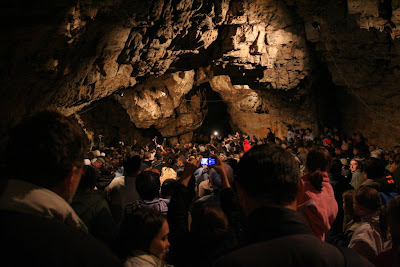
This weekend I went the Romanesti cave for a concert put on by the Banat Philharmonic from Timisoara. Last year I tried to attend the concert, but, because of a misunderstanding about the date, I ended up arriving a week too late. This year, however, I managed to see the concert. I tagged along with a group of teachers and students from the high school. After the concert we went for a nice walk through the woods. The weather was great! Check out the pictures:


Monday, October 13, 2008

For me, the perfect fall day includes a number of elements: clear skies, crisp air, rich-colored foliage, country drives, sweaters, cider, apple-picking and pumpkins. Although the autumn season in Romania is quite different from what it is in the North-Eastern US, there is still a lot to enjoy about it.

For example, the weather this past weekend was gorgeous. Even if the air wasn't as cool and crisp as I like it (actually, it was quite warm), at least it was sunny and clear. And, while I wasn't able to go for drive through the countryside, I did manage to go for a bike ride-- which was probably a better choice anyway.

Early Saturday morning two of my students from the 11th grade (Emma and Paul) and I boarded a train to Margina (a town in Eastern Timis county, on the 'margins' as it were). We had our bikes with us, and since we couldn't manage to fit them in the seating compartments, we had to stand with them in the hall. Luckily, it was a super 'low-budget' train, so they're somewhat lax about the bike fee. When the controller came to see our tickets, he didn't seem too surprised by our bikes; apparently he was pretty accustomed to seeing passengers in the halls with bikes. He did, however, mention the extra fee. Paul, as kindly as he could put it, asked, "but can't we come to some sort of understanding?" We could tell by his demeanor that the controller was a jolly old fellow, and he said, "aw heck, just leave some money in the controller's compartment at the end of the car." So we did.

So, the upside of the cheaper trains is that you can still get away with things like that. However, the downside is that they're extremely slow, and they stop at every village, intersection, sign post, and chicken coop along the way. So, after 1 and a half hours we had covered the 40km to Margina. We bought some supplies at a little corner shop, and headed on our way towards the village of Romanesti.

We took a dirt road through corn fields, lined with old wooden telephone poles and trees with bright yellow leaves (if they hadn't already turned brown). I certainly miss the vibrant colors that characterize fall in New England-- the reds and oranges--but the scenery was still interesting. Entire families seemed to be rustling among the cornstalks to gather the cobs (It looked like everyone had come out: parents, children, cousins and even grandparents and grandchildren). They dumped the fruits of their labor into horse-drawn carts to be carried back to the village for winter.

We finally arrived in Romanesti, where the scenery changed from cornfields and wagons full of corn cobs to houses and wagons full of wood-- yet another preparation for winter. When wood is delivered to a home, it is usually dumped on the street/sidewalk in front of the home, where it is sorted, chopped and then carried inside the gate to be stacked and stored. Our arrival in Romanesti was welcomed by the sights and sounds of men hard at work doing exactly that. In one particular area of the village the road runs parallel a little brook. I noticed the brook had a reddish tinge to it. There was a pungent smell in the air, the smell of woodsmoke mixed with fermenting plums--unmistakable signs that the villagers were making tuica.

From the main street in Romanesti we took a left up a dirt road to the Romanesti cave. Not more than 200 yards up the road we came to a hill on top of which there was a cemetary and an old wooden church (imagine a log cabin with a steeple). After about 40 minutes we came to the cave, and equipped with flashlights and headlamps, went inside. Almost immediately the bats greeted us by diving at our heads. I took a moment to throw pebbles up in the air and watch as the bats dove at them, thinking they were bugs-- an old trick my father taught me (he knew it doesn't take much to entertain me). As we went farther into the cave, the squeaks of the bats grew louder and the filth covering the rocks and ground also increased (ewww). There were several different routes and passages leading off the main chamber, so we took some time to explore them. I took a few pictures, which you can see at the link below.

After finishing at the cave, we went back the way we had come from Romanesti and then continued our bike ride on through the village of Tomesti, until we reached Liman's Valley. Unfortunately, we couldn't go any further because we had a train to catch. So we turned around and headed back to Margina. Once we got back to the train station, we found there was no one at the ticket office, which is quite typical for such small towns, which don't generally see a lot of traffic. So Paul asked around, and a little boy told him to knock on a specific door. He did so, and the door opened, the station guard emmerged, and Paul asked for tickets to Lugoj. 'So,' I thought to myself, 'that's how it works at these smaller stations!' It was actually kind of a revelation for me because, up until this point, if I hadn't found anyone at the ticket booth, I'd just board the train without a ticket and then buy one from the controller, explaining that I wasn't able to get a ticket at the station-- which is much more complicated than what Paul did. We got our tickets, little pieces of cardboard pre-stamped with the station of origin, the destination and the cost. Tickets from larger stations are usually printed out by a computer. However, many of the smaller stations still use this old-fashioned system, a remnant of a time before there were computer systems to manage ticket sales. The way this manual system works is very simple. There is a wall of hooks in the ticket office. On each hook hang cardboard tickets for every possible destination. So, the ticket vendor must select the proper ticket from many variants arranged on the wall. Think of it as the telephone switchboard of train stations.

The cardboard ticket

The next morning I got a phone call. It was from Tibi, who you may remember from my post of June 10th. He said, "I'm going to the village today to pick grapes. I'm leaving now; do you want to come?" Once again, no advanced warning, but I've come to expect that from Tibi. I said, "sure, why not." After all, I had helped him pick plums in Tapia (a village just outside Lugoj) a few weeks before, and I had said I'd like to help him again if he needed it. I like doing physical work; it's a good break from school. Moreover, I like working with Tibi, he's got a great attitude and a sense of humor to match. I also like going to the village to see his mom and eat some of her delicious Hungarian cuisine.

We picked grapes till all the buckets were overflowing. The whole time we talked. I enjoy talking to Tibi because he doesn't know English (only Hungarian and Romanian), so I'm forced to express myself in Romanian. I think I've improved quite a bit with my fluency from talking to him. When I first met him I had a hard time following what he said, but now I understand most everything, expect maybe for a few words here and there. At one point he asked me, "what do you gain from coming to Romania as a volunteer?" This was a whopper for me to explain in Romanian, but in the end I got my point across. I tried to explain to him that the idea behind the PC is to promote frienship between America and the rest of the world. I also told him that my object wasn't something concrete; it's more like I was interested in seeing another part of the world, experiencing new things, meeting new people, forming friendships, etc. Sometimes locals find it hard to comprehend why someone would come to Romania. It would seem that such individuals think that Romania is the armpit of Europe, and when I tell them that I don't get paid, they look at me like I'm stupid. I guess they're thinking the experience is nothing but a loss if there's no financial or material gain. While I was explaining to Tibi why the Peace Corps is a good thing, I was worried he might counter me with such a mentality. However, not only was he very accepting of my reasons, but he seemed to completely empathize.

As we continued to pick grapes, Tibi expressed his desire to learn some English. I took the opportunity to turn the tables and began talking to him in English, followed by Romanian translations of what I had said. Eventually he decided the langauge was too frustrating, and wanted to stop. So, I asked him to teach me some Hungarian, which I've heard is an extremely hard language. I came to discover what they say isn't just a rumor. After about fifteen minutes of attempting to pronounce egészségedre ("to your health"), my brain hurt too much to continue. He and his mother kept laughing at me because apparently I was saying egész seggedre, which basically translates to "to your ass!" It took me a while to percieve the difference in pronounciation between the two words, in fact I'm still not completely sure about it. Every time I thought I was starting to get the hang of it, they'd point out my failure. Nothing I said seemed to be right. Tibi’s mother kept repeating, "Nem seggedre! ségedre. Ha ha ha." No matter how hard I tried, I just couldn’t seem to differentiate the e sound from the é sound. I was completely frustrated, but I kept mulling it over and every half an hour or so I'd say it out loud again to see if I had pronounced it correctly. Most of the time their laughter confirmed my suspicions. Just goes to show you how a minor change in inflection can make all the difference between toasting someone's health or their rear-end.

Click below for some pictures from the weekend:


Monday, September 22, 2008

Szekszard

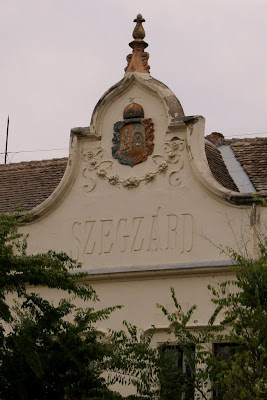
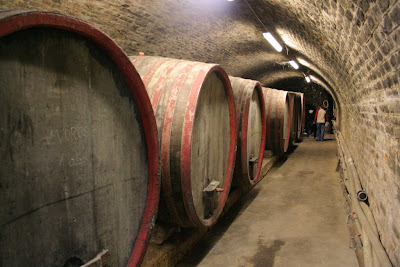
This past weekend I went to the Szekszard Wine Festival. The city of Szekszard, located in Southern Hungary, is known for its wine (by the way, "sz" in Hungarian is pronounced like an "s" in English). I traveled in a minibus with about 20 people from Lugoj; a group of kids from the Lugoj Kid's Club had been invited to perform at the festival (and I was invited to tag along).


We arrived after about 6 hours, ate lunch and were shown around town by some of the locals. We were even given a private tour of the history museum--I didn't understand what the curator said, but luckily a couple people in our group spoke Hungarian and could translate into Romanian.

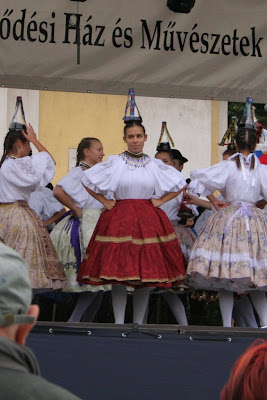
The official opening of the festival was held later that evening in the main town square. They had a showcase of traditional Hungarian dancing on a large stage. I was impressed how the women danced with decanters of wine on their heads, and the men clapped, stomped and slapped their boots in time. The rhythmic effect of the men stomping and pounding was quite powerful. I liked the music too, mostly violin and acoustic bass.


The next day we went to a function at the town hall. All the local officials were out, wearing cloaks (traditional costume I suppose). Speeches were given, and then an important-looking man took a glass and went over to the fountain in front of the town hall. He put his glass up to the spicket, turned it on and--get this-- out poured red wine! In fact there were two spickets on the fountain, one for red wine, the other for white. Glasses were handed out to everyone there, and we obligingly filled them. Imagine that, a wine fountain!

After that, there was a long parade down the main street. All the local wine producers were represented, along with all the schools, several organizations and many dance troupes. I was also surprised to see the mayor of Lugoj marching in the procession! Like us, he was an invited guest (probably because Szekszard and Lugoj have some economic partnerships).

Later on the second day, our kids performed. One group did a breakdance routine, the other was a rock band; they were both really good. By the time their acts were over, it was cold and we were all very hungry. We had meal tickets for one particular restaurant, which had set up a tent amidst all the wine tents. The only problem was that we had to sit outside. But I, for one, was too hungry to care; I ate despite the icy mist and stinging breeze. Luckily, the food was very good (turkey shish-kebabs, a pork cutlet, french fries and a sour cream sauce with cucumber, onion, and garlic). And, for a little added warmth, we drank hot mulled wine.

On the morning of the third day the kids performed once more. Next to the stage was a kiosk selling candies, so I took the opportunity to buy a few things. I bought some honey biscuits/cookies, some dianas cukorka candies (pronounced "deeoh-nash tzookorko," which are filled with a cough-syrup sort of liquid) and some krumplicukor (a hard white block; I was told it's a mixture of sugar and potatoes-- kind of disappointing as it turned out).

All in all, it was an interesting experience. Not only did I get to see another part of Hungary and bond with some of my fellow Lugojeans, but I also got a bottle of Szekszard wine!


See all the pictures HERE

Monday, September 15, 2008

Back to School

Primul Clopotel. It means, "the first bell," and is the ceremony that marks the start of a new school year.

This morning was gloomy and damp, but the rain held off just long enough for the ceremony to take place in the school courtyard. In attendance were all the teachers, the students (including the trembling hordes of 9th graders), the principal, the mayor (who just last year was the school's principal, but ran for office and won), a few graduates from last year, several parents, and numerous other important community members.

There was a blessing given by an Orthodox priest. Then came a speech by the principal, followed by the mayor's speech (coincidentally the same speech he gave last year when he was principal) and another speech I couldn't hear or understand because the speaker was talking too softly. The main focus of the ceremony was the pairing of the new 9th graders with their class teachers (dirigintii).

The ninth grdae, like other grades, is split into 5 different sections (9A, 9B, 9C, 9D, 9E). Each section specializes on a certain subject. For example, 9A focuses on mathematics and information technologies, 9C is a section for students who study sciences, 9D is the bilingual section (they have an intensive focus on English), and 9E is for the German-speaking students (several of their subjects are taught in German).

At the ceremony, each of the groups of 9th graders gathered behind their respective diriginte. This person acts sort of like the class's "home-room" teacher from the time their freshmen until they graduate. Thus the diriginte and their class tend to become quite close; the matching of a class with a diriginte that takes place at the opening of the school year is the start of a long relationship.

After the opening ceremony, all classes met with their diriginti for an hour or so. Then, the teachers met in the meeting room for a general start-of-the-schoolyear meeting. Classes officially start tomorrow, but I still don't have a schedule, nor do I know which classes I'll be teaching. The same thing happened last year-- school began with a chaotic bang. Everything was so new and confusing, and I wasn't even sure what classes I was teaching or when for the first few weeks. I was so stressed out by all the uncertainty and seeming chaos. Now, a year later, I realize this is just how they do things here. Rather than preparing everything before school starts, they sort of figure it out as they go. Which certainly is a different approach than what I remember from school in the States. But, that's all it is--different--not neccessarily better or worse. So, tomorrow I'll go to school and just go with the flow; I know things will be worked out in the end.

It's hard to believe that today essentially marks the start of my second half of Peace Corps service. I feel prepared for what lies ahead, with a year of experience under my belt and a better understanding of how things work. In fact, after a summer of sleeping in, I think the biggest challenge I face right now is re-training my body to get up in the morning.

Spor la treaba
to all my students and colleagues!