On Saturday I was visiting Timisoara with Kirstin (a volunteer from the area), and we happened upon a pile of garbage on the side of the road. It immediately appeared more interesting than your typical trash heap, containing a very old television, a number of old books, and lots of communist-era newspapers.
We walked over to it, and rummaged through some of the books. There were a couple 1974 Dacia owner's manuals (Dacia is a Romanian car company), there was a school notebook from the 60's, and a rather unassuming piece of folded cardboard.
Kirstin picked up the board and dusted it off to reveal red block letters that spelt "Capitaly." What could this be? She unfolded it, and discovered board was in fact a game, a Monopoly knock-off! The railroad company was CFR (Romania's train company). All the real estate spaces were famous parks and streets in Romania. Instead of Jail, there was a psychiatric ward. When passing "start," the player would be paid the equivalent of something like a few cents in today's money.
It was quite an interesting find. Kirstin decided to keep the board. It's funny to think that perhaps people were playing this game during communism. Perhaps they modified the rules so that the one who 'wins' would automatically be forced to redistribute his wealth among the rest of the players (thus the game would never end!). We joked about making up rules about food rationing, collectivization of property and nationalization of businesses.
I did a google search on 'Capitaly,' and found out it was originally a Hungarian take on Monopoly. This particular board, however, was a Romanian version.
Sunday, April 13, 2008


Pictures of Timisoara
For as often as I visit Timisoara, I've never actually taken any pictures. So, at long last, here are some (click on the slideshow below):
Wednesday, April 2, 2008
Rain drops keep falling on my head...
This anecdote was just too strange not to post...
So, today I came home after school to find a slip of paper stuck in my door. At first I thought it was a notice that I'd received a package, but this piece of paper was much bigger than normal. I pulled it out and unfolded it. It was a nondescript letter printed on very cheap paper, addressed to no one in particular.
It informed me that the town water company, SC Meridian, was going to be collecting its standard "meterological water" charges. "Hmm, meteorological water. What could that mean?," I thought to myself. "Could they mean rain?" I read on to find out more. The letter went on to request that residents complete a simple form and return it to the company, so they could calculate the proper charges. The form asked some seemingly silly questions, like: out of what materials is your place of residence constructed? Does your property include terraces, driveways, etc made of asphalt or concrete? Are there any sport complexes nearby? Do you have a gutter system? I'm not sure if I translated it correctly, but I think there may have also been a question about the estimated amount of rainwater that has fallen off my roof (how would I even attempt to calculate this?).
All this seemed too ludicrous to be true, so I took the slip over to the land-lady's to talk to her about it. I thought perhaps it was a belated April fool's joke. Paying a tax for the rain? Come on now, how can they be serious? However, my land-lady assured me it was not a joke. The water company was in fact charging the town residents for rainwater. She said they do it quarterly (funny that this was the first notice I'd received). She took my form and said she'd fill it out and submit it for me.
So, I guess now I just wait for the bill. I don't really understand the idea behind this tax. It would seem the water company is just fishing for an extra buck or two. The best I can figure is that the money is for maintenance of the drainage and sewage systems. But if that's the case, why not just call it the "drainage and sewage tax"? I'd be impressed if the city uses the money to control pollution of storm water. Who knows.
In any case, I was somewhat surprised, and rather amused by these "meteorological" charges. The whole situation reminds me of the Beatles song "Tax Man."
So, today I came home after school to find a slip of paper stuck in my door. At first I thought it was a notice that I'd received a package, but this piece of paper was much bigger than normal. I pulled it out and unfolded it. It was a nondescript letter printed on very cheap paper, addressed to no one in particular.
It informed me that the town water company, SC Meridian, was going to be collecting its standard "meterological water" charges. "Hmm, meteorological water. What could that mean?," I thought to myself. "Could they mean rain?" I read on to find out more. The letter went on to request that residents complete a simple form and return it to the company, so they could calculate the proper charges. The form asked some seemingly silly questions, like: out of what materials is your place of residence constructed? Does your property include terraces, driveways, etc made of asphalt or concrete? Are there any sport complexes nearby? Do you have a gutter system? I'm not sure if I translated it correctly, but I think there may have also been a question about the estimated amount of rainwater that has fallen off my roof (how would I even attempt to calculate this?).
All this seemed too ludicrous to be true, so I took the slip over to the land-lady's to talk to her about it. I thought perhaps it was a belated April fool's joke. Paying a tax for the rain? Come on now, how can they be serious? However, my land-lady assured me it was not a joke. The water company was in fact charging the town residents for rainwater. She said they do it quarterly (funny that this was the first notice I'd received). She took my form and said she'd fill it out and submit it for me.
So, I guess now I just wait for the bill. I don't really understand the idea behind this tax. It would seem the water company is just fishing for an extra buck or two. The best I can figure is that the money is for maintenance of the drainage and sewage systems. But if that's the case, why not just call it the "drainage and sewage tax"? I'd be impressed if the city uses the money to control pollution of storm water. Who knows.
In any case, I was somewhat surprised, and rather amused by these "meteorological" charges. The whole situation reminds me of the Beatles song "Tax Man."
Sunday, March 30, 2008
Primavara
It seems that spring has arrived! The trees are budding, the flowers are blooming, the weather is getting warmer, and the birds are building a nest in the awning above my window.
Daylight-saving-time began at 3:00am today, three weeks after the United States. Getting up this morning was more difficult than usual (but heck, it's always a chore for me). I hate losing that precious hour of sleep, but I'm looking forward to the longer days.
Yesterday I spent the day with some other volunteers in the nearby town of Deta. The weather was warm and sunny, so we took a grill out to a nearby pond and had a barbeque. We grilled potatoes along with the standard summertime favorite: mititei (meeteetay), also known as mici (meech). Mici are essentially a mixture of ground meat (pork, beef, lamb) spiced with herbs, rolled into a sort of sausage shape and served with bread, mustard and beer. Think of mici as the Romanian version of the hamburger.
Daylight-saving-time began at 3:00am today, three weeks after the United States. Getting up this morning was more difficult than usual (but heck, it's always a chore for me). I hate losing that precious hour of sleep, but I'm looking forward to the longer days.
Yesterday I spent the day with some other volunteers in the nearby town of Deta. The weather was warm and sunny, so we took a grill out to a nearby pond and had a barbeque. We grilled potatoes along with the standard summertime favorite: mititei (meeteetay), also known as mici (meech). Mici are essentially a mixture of ground meat (pork, beef, lamb) spiced with herbs, rolled into a sort of sausage shape and served with bread, mustard and beer. Think of mici as the Romanian version of the hamburger.
Thursday, March 13, 2008
Teaching English Is Easy, Changing Minds Is Hard
Last week I was visited by the fellow who served as a volunteer in Lugoj before me. He had finished his service a few days before my arrival, so we never got the chance to meet face-to-face before last week. But he came back to Romania for a visit, and was passing through town.
Since he had been home for nearly 8 months, it was interesting to talk to him about what has changed in Lugoj since he left. Of course some minor things have changed--a restaurant closed, a new one opened, some buidings have been painted, etc--but basically things have stayed the same. In fact, this was his general impression of the whole country. He said that it felt like nearly nothing of substance had changed in Romania, and for him, this was somewhat disappointing.
Before he left Lugoj, he gave me a copy of a magazine about Romania called Vivid: Romania through international eyes. As the name implies, the publication contains commentary on Romania written by foreigners. I looked it over, and found a couple articles that echoed the very sentiment that my fellow volunteer had: change simply isn't happening quickly enough.
I photocopied one of the articles and brought it in to school to discuss with my students. The article was somewhat harsh on Romanian politicians, claiming their selfish greed is the cause of just about every problem in Romania. My students generally agreed with this position, saying that politicians always make promises, but nothing ever really gets done. They don't have the country's interests at heart; they're more concerned with making a quick buck (or Leu, as would be the case in Romania). I was surprised how accepting my students were of this fact. When I asked them, "How can we fix this?" some of them responded, "What can we do? We can't change anything, this is just the way it is."
'Asta e viata' (or, 'such is life') is a typical saying in Romania. It seems to reflect a broad cultural outlook, perhaps left over from communism. It also sums up the general sense of apathy and disillusionment. Everyone knows what their politicians are doing, but will it ever get any better? Many people I've talked to don't seem to have any reason to think so; it's just the way things are. This sort of thinking is especially common among the older generations who have seen governments and leaders come and go. However, sadly, this outlook is even spreading to the youth; ineffectual leadership is all they've ever known.
I can understand why many Romanians are frustrated with the way things are going in Romania. Its been nearly 20 years since the Revolution, and things have changed, but not enough. The Revolution was certainly a turning point, and it brought with it hope for the future. But, that future has come, and for many Romanians, things didn't turn out quite as expected.
As mentioned in the Vivid article, the corruption is certainly one part of the picture. For politicians, money seems to take priority over the real issues--like the ailing economy, crippled healthcare system, or grossly under-funded educational system. In this post-communist age, when it's possible to accumulate some money, these politicians are taking full advantage of the situation--even if it means cheating the system. Perhaps they're sort of like the kid who sneaks over to the neighbor's house to play Super Mario Brothers because his mom never let him play video games.
In any case, because politicians don't have their fingers on the pulse of the nation, and because nothing seems to change in their country, Romanians lack any considerable faith in their political system. Apathy is more common than activism because people feel that trying to enact change is futile. They do their part, they vote, and things remain the same. So, what else can they do? Trying to tackle this "what can I do?" attitude is one of the most challenging, and sometimes discouraging things about being a Peace Corps volunteer in a post-communist nation.
One question I used to get a lot was, "why did you come here???" As if to imply that no one in their right mind would leave the United States to come to a place as terrible as Romania; many think the place is a lost cause (which explains why a lot of young Romanians move abroad). This attitude is so commonplace. But I try to do what I can to chisel away the pessimism, even if it may be an uphill battle.
When one's goals are so intangible, it's hard to gauge results. Sometimes I wonder what sort of effect I'm having. I'm sure my presence here is doing something, it's just hard to tell sometimes. A Peace Corps volunteer in Africa may help build a latrine, and be able to look back and say, "I did that." In some ways, I envy that sort of 'instant gratification.' For volunteers in a place like Romania, instant, visible results aren't always the case. This can make one feel ineffectual at times. But, just because the results can't be seen doesn't mean they aren't there somewhere under the surface.
I'd argue that being an effective volunteer is made more complicated because of Romania's level of development. Some people jokingly call the Peace Corps in Eastern Europe the "Posh Corps." It's true that we have access to restaurants, grocery stores, trains, cinemas and many other western amenities. Romania is certainly further developed than just about every other Peace Corps country, but that doesn't mean that the job is any easier. In fact, the situation here implies a different set of responsibilities. We're dealing with more complicated problems, like the culturally-ingrained pessimism that I mentioned. Such 'intangibles' present the volunteer with a unique set of challenges, the solutions to which aren't always as straightforward as finding away to supply a village with clean water.
All I can hope is that my presence as a volunteer is having some impact, no matter how small. Even if I help to influence just one person, that's something. I suppose it all depends on one's definition of success. I certainly don't expect to single-handedly turn Romania into a nation of optimistic, politically-active citizens. However, if I can inspire a few people, maybe they'll go on to inspire others, and so on. I've noticed a lot of potential in Romania's youth, and that's why I think it's so important for them to take an active interest in their country's future. Some of them do have a genuine interest, but it'll take more. Many educated young Romanians leave the country in search of higher-paid jobs, causing a national "brain-drain." Working abroad may be a fine solution for the here-and-now. But if everyone left the country, who would be left behind to tackle the real issues? Romania's problems affect everyone, and require a collective response. There is no doubt that the process of building civil awareness takes time. I just hope that when it comes time for the post-communist generation to take the reigns they steer the country in a positive direction.
One question I used to get a lot was, "why did you come here???" As if to imply that no one in their right mind would leave the United States to come to a place as terrible as Romania; many think the place is a lost cause (which explains why a lot of young Romanians move abroad). This attitude is so commonplace. But I try to do what I can to chisel away the pessimism, even if it may be an uphill battle.
When one's goals are so intangible, it's hard to gauge results. Sometimes I wonder what sort of effect I'm having. I'm sure my presence here is doing something, it's just hard to tell sometimes. A Peace Corps volunteer in Africa may help build a latrine, and be able to look back and say, "I did that." In some ways, I envy that sort of 'instant gratification.' For volunteers in a place like Romania, instant, visible results aren't always the case. This can make one feel ineffectual at times. But, just because the results can't be seen doesn't mean they aren't there somewhere under the surface.
I'd argue that being an effective volunteer is made more complicated because of Romania's level of development. Some people jokingly call the Peace Corps in Eastern Europe the "Posh Corps." It's true that we have access to restaurants, grocery stores, trains, cinemas and many other western amenities. Romania is certainly further developed than just about every other Peace Corps country, but that doesn't mean that the job is any easier. In fact, the situation here implies a different set of responsibilities. We're dealing with more complicated problems, like the culturally-ingrained pessimism that I mentioned. Such 'intangibles' present the volunteer with a unique set of challenges, the solutions to which aren't always as straightforward as finding away to supply a village with clean water.
All I can hope is that my presence as a volunteer is having some impact, no matter how small. Even if I help to influence just one person, that's something. I suppose it all depends on one's definition of success. I certainly don't expect to single-handedly turn Romania into a nation of optimistic, politically-active citizens. However, if I can inspire a few people, maybe they'll go on to inspire others, and so on. I've noticed a lot of potential in Romania's youth, and that's why I think it's so important for them to take an active interest in their country's future. Some of them do have a genuine interest, but it'll take more. Many educated young Romanians leave the country in search of higher-paid jobs, causing a national "brain-drain." Working abroad may be a fine solution for the here-and-now. But if everyone left the country, who would be left behind to tackle the real issues? Romania's problems affect everyone, and require a collective response. There is no doubt that the process of building civil awareness takes time. I just hope that when it comes time for the post-communist generation to take the reigns they steer the country in a positive direction.
Tuesday, February 26, 2008
Shadows of the Past
I just found this article. Apparently there is an ongoing debate about the release of old Securitate surveillance files (the Securitate was secret police organization during the communist period).
Interestingly enough, after the Revolution, no high-ranking communist officials were prosecuted. They simply continued on with life as usual, and many of them are still involved with the government. This, one can guess, has been a hindrance in settling this debate. But, those who suffered during communism because of their opposition to the regime want to have some degree of justice and some sense of closure. Thus, the release of this information is very important to them, and understandably so.
This whole situation seems to indicate how Romania is still dealing with ghosts from its past. Getting out from under the shadow of communism is certainly a process, to say the least.
Interestingly enough, after the Revolution, no high-ranking communist officials were prosecuted. They simply continued on with life as usual, and many of them are still involved with the government. This, one can guess, has been a hindrance in settling this debate. But, those who suffered during communism because of their opposition to the regime want to have some degree of justice and some sense of closure. Thus, the release of this information is very important to them, and understandably so.
This whole situation seems to indicate how Romania is still dealing with ghosts from its past. Getting out from under the shadow of communism is certainly a process, to say the least.
**********
Here's another piece of news I've found. It seems that Romania wants to position itself as a mediator between the EU and Serbia in dealing with the issue of Kosovo. Obviously Belgrade doesn't want to be isolated from the rest of the European community. However, neither does Bucharest, but its refusal to recognize Kosovo hasn't helped in this regard. By positioning itself as the middleman, Romania would not only be able to help reconcile Belgrade with the rest of Europe, but it would also be able to keep its own "community" image in good standing.
Here's another piece of news I've found. It seems that Romania wants to position itself as a mediator between the EU and Serbia in dealing with the issue of Kosovo. Obviously Belgrade doesn't want to be isolated from the rest of the European community. However, neither does Bucharest, but its refusal to recognize Kosovo hasn't helped in this regard. By positioning itself as the middleman, Romania would not only be able to help reconcile Belgrade with the rest of Europe, but it would also be able to keep its own "community" image in good standing.
Sunday, February 24, 2008
Explorations
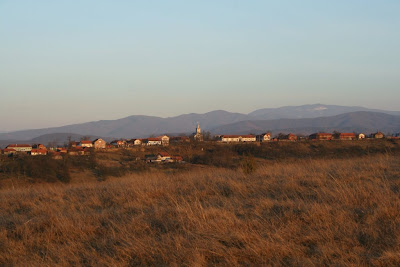
The weather was incredible today, so I went for a little trip to the outskirts of town, and discovered this village. I don't know its name.
(Update: It's Poganesti)
Here's the rest of the pictures:
Friday, February 22, 2008
Kosovo
Since Kosovo declared its independence earlier this week the situation in Serbia seems to be tense. I haven't heard too many Romanians talking about it. But, I gather that Romania will not recognize Kosovo in order to maintain its ties to Serbia. What I wonder is exactly how close the two neighbors are. I'm sure there may be more going on than what I can see, but I haven't seen or heard of any clear examples of a close relationship. Years ago Serbia and Romania joined forces to create a hydro-electric dam on the Danube and today they share the electric output. However, I can't say I know of any other examples of cooperation. I mean, I haven't found a Romanian bank that will change Serbian money. Seem strange? They are neighbors after all.
I've also heard that the Romanian government is reluctant to make any official statements of support since it's worried that Kosovo might set a precedent for other separatist movements. Romania itself has had some issues with territorial disputes (The area now known as The Republic of Moldova was separated from Romania in the 1940s. Moreover, there have been years of ethnic tensions in the Transylvania region, to some degree at least. The sizable Hungarian minority in the area hasn't always mixed well with Romanians. In fact, they claim that Transylvania is rightfully a Hungarian region. I've even been told that such Hungarians view Budapest to be their capital, not Bucharest. So, perhaps Romania can at least sympathize with Serbia's wish for national unity. And, considering these things, it becomes more apparent why Romania wouldn't wish to say anything that might tacitly encourage another separatist movement (whether within their own borders or elsewhere in Europe).
In any case, it will be interesting to see how Romania reacts to the current situation. I wonder if the EU will put any pressure on Romania to recognize Kosovo. In any case, with the recent attack on the US Embassy in Belgrade, and general uncertainty about what will happen next, one thing is for sure: I think I'll put any trips to Belgrade on hold for a while.
I've also heard that the Romanian government is reluctant to make any official statements of support since it's worried that Kosovo might set a precedent for other separatist movements. Romania itself has had some issues with territorial disputes (The area now known as The Republic of Moldova was separated from Romania in the 1940s. Moreover, there have been years of ethnic tensions in the Transylvania region, to some degree at least. The sizable Hungarian minority in the area hasn't always mixed well with Romanians. In fact, they claim that Transylvania is rightfully a Hungarian region. I've even been told that such Hungarians view Budapest to be their capital, not Bucharest. So, perhaps Romania can at least sympathize with Serbia's wish for national unity. And, considering these things, it becomes more apparent why Romania wouldn't wish to say anything that might tacitly encourage another separatist movement (whether within their own borders or elsewhere in Europe).
In any case, it will be interesting to see how Romania reacts to the current situation. I wonder if the EU will put any pressure on Romania to recognize Kosovo. In any case, with the recent attack on the US Embassy in Belgrade, and general uncertainty about what will happen next, one thing is for sure: I think I'll put any trips to Belgrade on hold for a while.
The Butter Battle Begins
After I finished teaching for the day I went to the English teachers' room. Our lair is a relatively small space, filled with a large conference table, 15 chairs, a computer and a xerox machine. I sat at the computer to check my email when a fellow teacher approached and started talking to me about Romanian cooking. This particular teacher knows that my new favorite hobby is to cook, so she gives me her tips and advice. She teaches French at the school, and is married to the head of the English department. She loves cooking, she loves talking and, even more, she loves talking about cooking.
Once you get her on the subject, she'll go on and on. Her enthusiasm is really something. The only problem is that she talks so quickly I sometimes have a hard time following her. The other teachers in the room find it ammusing to watch these exchanges--apparently my looks of confusion are evident to everyone but her. She just keeps on blabbering, apparently undiscouraged by my slightly vacant expression. Well actually, she does ocassionaly stop to say something like, 'I don't know how much of this you're getting...' I just smile and she continues on as usual. Not being able to get a word in edgewise, all I can usually do and nod my head and grunt, which is probably for the best (since I could never match her in speaking anyway).
Today the exchange was much the same. I actually do understand her fairly well, it's just hard to keep track of all the details when she's giving me a recipe that has multiple steps. Another teacher, one who doesn't usually spend much time in the English office, happened to be observing. She was surprised that the French teacher was talking to me in Romanian. 'He understands Romanian?!' she asked with a hint of surprised delight. At this point she entered the conversation. The French teacher and I happened to be discussing the intricacies of beef soup. Since we were on the topic of soup, the second teacher asked me if I happened to know how to make dumpling soup (supa cu galuşte, as dumplings are called in Romanian). Since I didn't, she took the opportunitiy to impart her wisdom on me. She described the process, but when she got to the part about the eggs, the French teacher piped in her objections, "No! that's not what you do with the eggs! You can't beat the whites and the yolks together. You need to beat them separately and recombine them, it's the only proper way to do it." The other teacher responded, "I'm just telling Mike to do it this way since it's easier." "Easier! Poppycock! It'll make the dumplings too hard," retorted the French teacher (she didn't actually say poppycock, I just added it for effect). A third teacher chimed in, "No, no, no. You've both got it wrong. You discard the yolk, beat the whites, add the farina a little at a time, along with a little oil." Everyone had their own opinion; the situation really demostrated that there can be such a thing as too many cooks in the kitchen.
I felt like I had somehow gotten myself caught in the crossfire of Dr. Seuss's great butter battle. Even more confused than before, I decided to go down to the cantina for lunch. When I came back up, I discovered a bag of farina, 6 carrots, and powdered chicken broth waiting on the table for me. Along with those items was a hand-written recipe from the second teacher (all in Romanian, with handwriting I could barely read). Apparently she went shopping to get me the particular type of farina that she always uses. I forgot to mention, there had also been a lengthy discussion about what sort of farina to use. Apparently, the second teacher was so concerned about me doing things "correctly" that she took it upon herself to make sure I had the proper supplies. Just another example of the typical Romanian woman's motherly instinct. You can imagine how worried they all are about this American boy, far from home, without a mother to cook for him (For example, whenever I visit my landlady, the conversation usually starts off something like this: "Are you hungry?" "No, thank-you" "How about a schnitzel?" "No, that's quite alright, thanks." "Ok, how about some eggplant salad?" "No thanks, I'm content" "How about some branza?" "Really, I'm not hungry." "Oh, not hungry, eh? Maybe you would just like some bread then?").
I was milling over the recipe instructions when the French teacher came back into the room. She knew that the other teacher had left them for me. Hinting at the fact that the recipe in my hand might lead me astray, she said, "you should really consider separating the white and yolk."
Well, when I got home I decided to make the soup-- I figured why not, I had all the neccessary items and some time to kill. So, I got out my pot and I deciphered the recipe. Now, I'm not sure if the French teacher's warning was prophetic, or if I had simply done something wrong, but the dumplings ended up being a little hard. However, all in all they weren't bad. Maybe next time I'll see if I get a different result by separating the eggs.
In any case I had an interesting cultural exchange today. And, I learned just how seriously Romanian women take their cooking, which is to say...quite seriously
Once you get her on the subject, she'll go on and on. Her enthusiasm is really something. The only problem is that she talks so quickly I sometimes have a hard time following her. The other teachers in the room find it ammusing to watch these exchanges--apparently my looks of confusion are evident to everyone but her. She just keeps on blabbering, apparently undiscouraged by my slightly vacant expression. Well actually, she does ocassionaly stop to say something like, 'I don't know how much of this you're getting...' I just smile and she continues on as usual. Not being able to get a word in edgewise, all I can usually do and nod my head and grunt, which is probably for the best (since I could never match her in speaking anyway).
Today the exchange was much the same. I actually do understand her fairly well, it's just hard to keep track of all the details when she's giving me a recipe that has multiple steps. Another teacher, one who doesn't usually spend much time in the English office, happened to be observing. She was surprised that the French teacher was talking to me in Romanian. 'He understands Romanian?!' she asked with a hint of surprised delight. At this point she entered the conversation. The French teacher and I happened to be discussing the intricacies of beef soup. Since we were on the topic of soup, the second teacher asked me if I happened to know how to make dumpling soup (supa cu galuşte, as dumplings are called in Romanian). Since I didn't, she took the opportunitiy to impart her wisdom on me. She described the process, but when she got to the part about the eggs, the French teacher piped in her objections, "No! that's not what you do with the eggs! You can't beat the whites and the yolks together. You need to beat them separately and recombine them, it's the only proper way to do it." The other teacher responded, "I'm just telling Mike to do it this way since it's easier." "Easier! Poppycock! It'll make the dumplings too hard," retorted the French teacher (she didn't actually say poppycock, I just added it for effect). A third teacher chimed in, "No, no, no. You've both got it wrong. You discard the yolk, beat the whites, add the farina a little at a time, along with a little oil." Everyone had their own opinion; the situation really demostrated that there can be such a thing as too many cooks in the kitchen.
I felt like I had somehow gotten myself caught in the crossfire of Dr. Seuss's great butter battle. Even more confused than before, I decided to go down to the cantina for lunch. When I came back up, I discovered a bag of farina, 6 carrots, and powdered chicken broth waiting on the table for me. Along with those items was a hand-written recipe from the second teacher (all in Romanian, with handwriting I could barely read). Apparently she went shopping to get me the particular type of farina that she always uses. I forgot to mention, there had also been a lengthy discussion about what sort of farina to use. Apparently, the second teacher was so concerned about me doing things "correctly" that she took it upon herself to make sure I had the proper supplies. Just another example of the typical Romanian woman's motherly instinct. You can imagine how worried they all are about this American boy, far from home, without a mother to cook for him (For example, whenever I visit my landlady, the conversation usually starts off something like this: "Are you hungry?" "No, thank-you" "How about a schnitzel?" "No, that's quite alright, thanks." "Ok, how about some eggplant salad?" "No thanks, I'm content" "How about some branza?" "Really, I'm not hungry." "Oh, not hungry, eh? Maybe you would just like some bread then?").
I was milling over the recipe instructions when the French teacher came back into the room. She knew that the other teacher had left them for me. Hinting at the fact that the recipe in my hand might lead me astray, she said, "you should really consider separating the white and yolk."
Well, when I got home I decided to make the soup-- I figured why not, I had all the neccessary items and some time to kill. So, I got out my pot and I deciphered the recipe. Now, I'm not sure if the French teacher's warning was prophetic, or if I had simply done something wrong, but the dumplings ended up being a little hard. However, all in all they weren't bad. Maybe next time I'll see if I get a different result by separating the eggs.
In any case I had an interesting cultural exchange today. And, I learned just how seriously Romanian women take their cooking, which is to say...quite seriously
Monday, February 18, 2008
December 16th, 1989
On Friday of last week I went to a presentation given by Dorel Jurcovan, a man who experienced the Romanian Revolution first-hand. He talked a bit about life during the last days of communism and showed a video about the Revolution from 1990.
 Dorel giving his talk
 The mob in front of the Opera. Notice the people up in the balcony
 A daily ration of butter. With this, you were expected cook, bake and butter your toast
**I don't pretend to be an expert on the Romanian Revolution. Nearly everything I've heard has been second-hand, so please let me know if I have any of the facts confused.
 Dorel giving his talk
It was very interesting to hear the story from someone who actually took part in the events. Dorel was involved in the first protest, which began

The square where it all happened (The Opera is at the far end of the square)
 The mob in front of the Opera. Notice the people up in the balcony
This sort of public gathering was unprecedented; under Ceauşescu even something as unassuming as 5 men gathering for a game of bridge was considered "subversive." So, needless to say, what happened in
Dorel vividly remembers the intensity of it all. He said it was almost too much to process at once. The daunting images still pierce his brain to this day: pools of blood on the groud, mutilated bodies, wounded people stacked in the trunks of cars with their feet dangling outside, soldiers shooting on the street, or pointing their guns at him. It was amidst this chaotic scene that something peculiar started to happen. Some of the soldiers stopped firing and started chant with the crowd. Apparently they too were fed up with the regime. This was a sign that the ground was truly crumbling under Ceauşescu's feet.
The video Dorel showed was very interesting. It was produced by an Irish news station (and, as far as I know, was never broadcast in
Word of the bloody events in
Why did the Revolution spark off when it did, and why in
 A daily ration of butter. With this, you were expected cook, bake and butter your toast
All of this was too much to take; having to deal with these sorts of things on a daily basis caused popular discontent to well-up under the surface until it finally erupted on that December day in
Laszlo Tokes, an outspoken Hungarian priest, provided the pretext for the events of December 16th. He had been using his pulpit to criticize the Communist regime. A known dissident, the government had been watching him for a while. Frightened for his life, Tokes essentially went into hiding in his home. After a while, the church decided it would be best if Tokes was removed from Timişoara and relocated to another Parish. His parishoners, of course, protested the idea, petitioned the bishop, and even tried to spread word of his plight to Hungary and beyond. On December 15th, a bold group formed outside his home to show their support and willingness to protect him. As Dorel related, Tokes's home was nearby a trolley stop, so the people who were gathering there conveniently made the excuse that they were simply waiting to pick up the next trolley. And, being a conspicuous event in a high-traffic area, the group continued to draw in curious onlookers, who joined in the action or at least spread word of what was happening. Soon hundreds had gathered to 'wait for the trolley.' What began as a protest of the harassment of one man quickly became a vehicle for protesting general frustrations, and a spirit of riot quickly ensued. Chants of "Save Tokes" eventually evolved into "we want freedom" or "down with Ceauşescu, down with communism!" From there, the crowd spread to the main square, and continued to gain momentum. The following days were enveloped in sheer bedlam.
The situation with Laszlo Tokes just happened to be the pin that burst the bubble, releasing everyone's pent-up aggravations. Conceivably, these events could have happened anywhere. But, they happened on that day in
After hearing Dorel speak, and seeing the images from the video, walking through downtown
**I don't pretend to be an expert on the Romanian Revolution. Nearly everything I've heard has been second-hand, so please let me know if I have any of the facts confused.
Subscribe to:
Posts (Atom)

